A decline bench earns its place only when regular users need heavy barbell chest training and the gym can provide safe spotting, adequate floor clearance and ongoing maintenance. By comparing its benefits, alternatives, specifications and ownership demands, you can decide whether to buy one or give priority to a flat or adjustable bench.
Key takeaways
- Choose flat or adjustable benches first when one pressing station must serve many users.
- Add a decline bench when heavy decline barbell demand justifies its dedicated floor space.
- Compare bench stability, machine safety, rack compatibility and user access before buying.
- Plan for dust, humidity, sweat and regular fastener inspections in Nagpur gyms.
When does a decline bench earn floor space in an institutional gym?
A decline bench press for institutional gyms in Nagpur earns floor space only when regular users already demand heavy barbell chest training. If the facility can buy one pressing station, choose a flat or adjustable bench: it supports flat and incline pressing, dumbbell work, seated exercises and more users.
A fixed decline bench for institutions is a specialist addition, not a foundation piece.
| Option | Main use | Priority when space or budget is limited |
|---|---|---|
| Flat bench | General barbell and dumbbell pressing, plus varied exercises | First choice for mixed-use facilities |
| Adjustable bench | Flat, incline and sometimes decline pressing with one frame | Best single-bench choice where versatility matters |
| Incline press | Upper-chest-focused pressing with greater shoulder flexion | Useful where users specifically train shoulders and upper chest |
| Decline bench | Lower-chest-focused barbell pressing with a shorter bar path | Add only after demand for decline work is proven |
| Setting | Sensible buying decision | When decline earns consideration |
|---|---|---|
| Schools and colleges | Flat or adjustable bench | A supervised strength programme has regular decline sessions |
| Police and defence facilities | Flat or adjustable bench first | Experienced trainees require high-load chest programming |
| Hospitals and workplaces | Adjustable bench | Users need exercise variety and easier progression |
| Other mixed-use gyms | Flat or adjustable bench | Decline users consistently occupy existing stations |
Count the operating envelope, not just the catalogue footprint: leave room for plates, foot-end access, a spotter, safe hand-off and removal for repairs. A decline station also needs secure leg restraint and compatible safety catches; without supervision and clear barbell rules, its extra risk and underuse rarely justify the cost.
What decline bench press benefits matter to different users?
The useful decline bench press benefits depend on the user, not the angle alone. Experienced lifters may value a shorter bar path, reduced shoulder flexion compared with incline pressing, and the ability to handle more weight. Beginners and rehabilitation-focused users usually gain more from an adjustable bench, lighter loading and easy supervision.
| User | Benefit that matters | Limitation |
|---|---|---|
| Experienced lifter | Heavier pressing with less shoulder flexion and a stable lower-pectoral bias | Heavier loads increase the need for reliable safeties and spotting |
| Beginner | A consistent movement path and confidence under moderate loads | It does not teach more pressing skills than a flat bench |
| Rehabilitation-focused user | Potentially less shoulder flexion than incline work | The fixed angle and entry position may not suit the injury or prescribed range |
| Mixed-use member | Variation for chest training | A dedicated station may sit unused beside a more versatile bench |
Decline pressing shifts emphasis toward the sternal, or lower, region of the pectoralis major, but it does not isolate a separate lower-chest muscle. The triceps and anterior deltoid still contribute, while grip width, elbow position, bar path, bench angle and individual anatomy change the result.
A shorter bar path can reduce total range of motion, so a heavier lift does not prove superior whole-chest development. Ankle rollers can help a shorter or less flexible user stay positioned, yet the wrong height can create ankle or knee pressure and complicate exit.
Test the setup across body sizes before treating these mechanical advantages as universal.
Which decline setup suits your institution: bench, machine or rack?
Choose a fixed decline bench for institutions only when barbell chest training has steady demand and trained staff can control each session. Otherwise, an adjustable bench or machine usually earns more floor space through broader use.
| Option | Best fit | Main trade-off | Supervision and throughput |
|---|---|---|---|
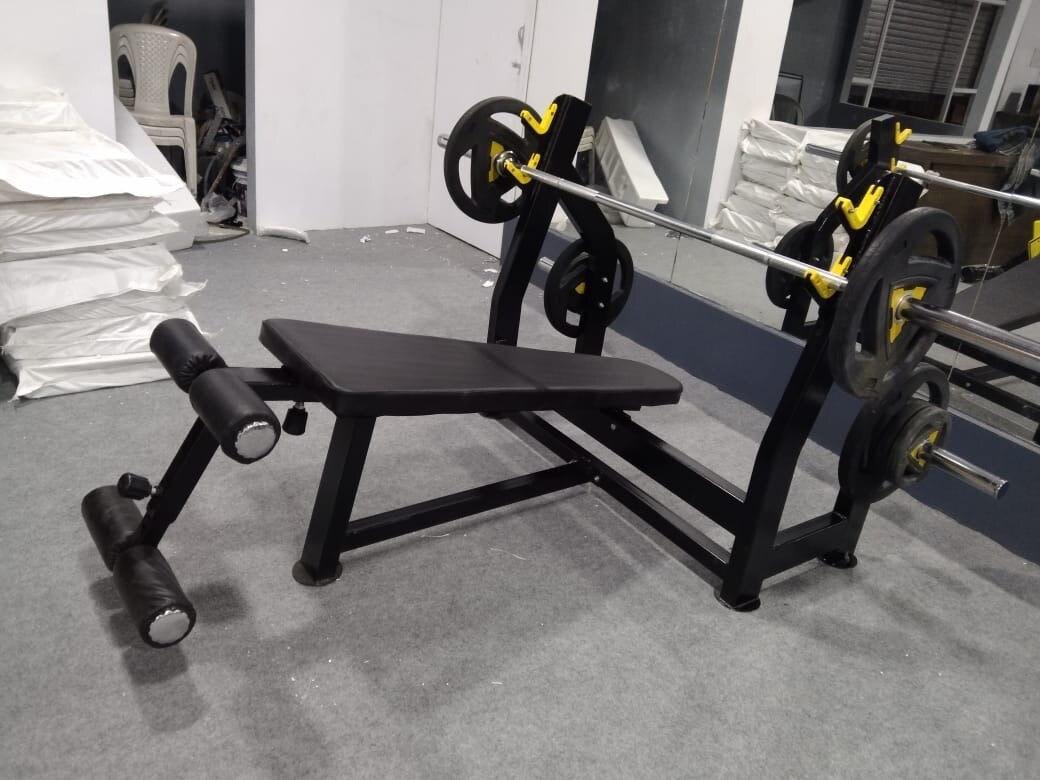
| Fixed decline bench | Regular barbell users needing quick setup | Robust, but limited to decline pressing | Requires hand-off, spotter access and strict loading rules |
| Adjustable bench set to decline | Mixed users needing flat, incline and decline work | More hinges, pins and adjustment points to inspect | Versatile, but slower to configure and easier to misadjust |
| Plate-loaded decline press machine | High-throughput rooms with varied ability levels | Less barbell skill transfer and fixed movement path | No hand-off; simple user turnover and easier independent use |
| Smith-machine setup | Facilities wanting guided pressing with adjustable angles | Bar path and bench alignment can suit some users poorly | Built-in catches reduce risk, but staff must set catch height correctly |
| Free-weight barbell station | Experienced lifters and coached strength programmes | Highest demand for rules, space and competent spotting | Best spotter access when the rack, bench and safeties match |
A commercial decline bench press needs more room than its catalogue footprint: leave loading clearance on both sides, access at the foot, a standing spotter position and a route for removal. Confirm Olympic-bar sleeve clearance, rack width, hook height and safety-catch range with your actual bar.
A decline bench for institutions is a poor choice when staff cannot enforce no-collar or load-limit rules, inspect catches routinely or provide a safe hand-off. In that setting, choose a plate-loaded machine or spend the budget on a flat or adjustable bench.
What should you inspect before buying a commercial decline bench press?
Measure the actual barbell system before approving a commercial decline bench press. A catalogue footprint is not enough: allow space for bar loading, plate storage, a close spotter and removing the bench for repair.
1. Test the decline angle, usable pad length and width, seat size, and leg-holder position. The pad must support short and tall users without forcing the shoulders off the bench. The pelvis must stay planted, and ankle or leg restraints must prevent sliding toward the head during unracking and heavy lowering.
2. Load your Olympic bar and inspect bar-sleeve clearance, rack width, hook height and bar-centre position over the shoulders. Check that spotting arms do not block the lift, a spotter can stand close without hitting the frame, and safety catches adjust quickly through the required range.
3. Request the maximum user-and-load rating, its test method, and whether it is static or dynamic and includes the rack. Inspect frame tubing, welds, upholstery seams and padding, transport wheels, rubber feet and floor protection.
Test the bench with a short, tall, light and heavy user before purchase. A decline bench press in Nagpur deserves commercial classification only when the supplier provides dynamic-rating evidence, robust adjustment hardware, accessible spotting and pad material that resists compression and tearing; a large advertised kilogram figure alone proves little.
Also confirm replacement catches, pins and upholstery are available.
How will Nagpur conditions affect maintenance and the final buying decision?
Nagpur’s heat, sweat, wet cleaning and monsoon humidity make upholstery and steel protection decisive ownership issues. Choose sealed upholstery edges, low-absorption or closed-cell padding, and powder-coated or corrosion-resistant steel; wipe sweat after sessions, use a controlled damp-cleaning process, and dry seams, pivots and the floor before storage.
Plan for the loaded bench, not its catalogue footprint. Leave access at the foot end, bar-loading space on both sides, plate-tree clearance, a spotter position and a route for removing the unit. Test ankle-roller height with short and tall users: poor positioning can hinder entry or create ankle pressure.
Before approving a decline bench press for institutional gyms in Nagpur, require:
- A written capacity basis stating whether the rating includes the user, whether the rack is included, and whether testing is static or dynamic; name the applicable fitness-equipment standard or test method.
- Replacement availability and prices for torn or compressed upholstery, pop pins, pivot hardware, end caps and safety catches; specify whether upholstery replacement is done onsite.
- A repair plan covering damaged welds, frame-finish corrosion and loose pivots, with inspection intervals, local technician coverage and maximum response time.
- Documented cleaning, drying and lubrication instructions, plus warranty exclusions for moisture, misuse and overloaded racks.
- A floor plan showing safe spacing and the unit’s removal route for service.
When comparing decline bench press in Nagpur suppliers, Singh Engineering Works is worth considering only if its written specifications, service coverage and repair capability match your documented demand. A fixed bench is a sound purchase only when regular barbell use justifies its dedicated floor area.
Frequently asked questions
When does a decline bench earn floor space in an institutional gym?
It earns space when regular users already demand heavy decline barbell training and the facility has enough general-purpose pressing capacity. Choose a flat or adjustable bench first when one station must support more exercises and users.
What decline bench press benefits matter to different users?
A decline press gives experienced lifters a dedicated angle for chest training and supports heavy barbell work. Beginners and mixed-use facilities often gain more from a flat or adjustable bench because it supports a wider range of exercises.
Which decline setup suits an institution: bench, machine or rack?
Choose a decline bench for free-weight users, a decline machine for guided resistance and easier supervision, or a rack-compatible bench when the institution needs shared barbell equipment. Compare capacity, spotting access, adjustability and floor use.
What should you inspect before buying a commercial decline bench press?
Check the frame welds, weight rating, pad thickness, upholstery seams, foot brace, adjustment hardware, bar clearance and spotter access. Test the bench for rocking, sharp edges and movement under load.
How will Nagpur conditions affect maintenance and the final buying decision?
Dust, sweat and seasonal humidity increase cleaning and corrosion-control needs. Select coated steel, sealed upholstery seams and accessible fasteners, then schedule inspections for bolts, welds, padding and moving parts.
Keywords